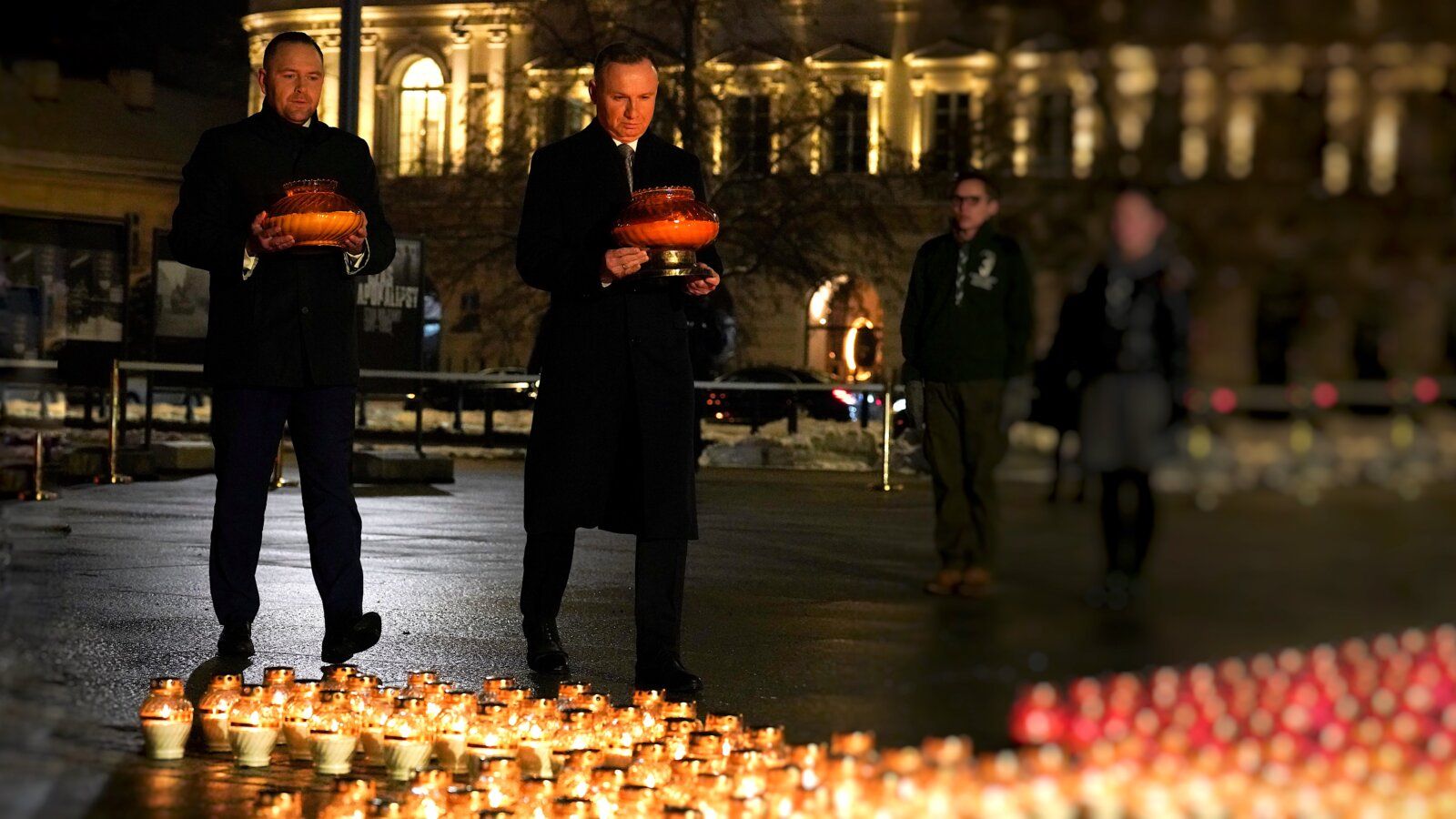
Poniżej publikujemy tekst prezesa IPN dr. Karola Nawrockiego w jęz. polskim, angielskim i francuskim.
Karol Nawrocki, Prezes Instytutu Pamięci Narodowej
Zamach na „Solidarność”
Jest godzina 6 rano. Huk i dwa kolejne potężne uderzenia. Czołgi sforsowały naszą barykadę”. Tak Anna Walentynowicz, legendarna suwnicowa i działaczka NSZZ „Solidarność”, zapamięta 16 grudnia 1981 roku. To czwarty dzień stanu wojennego – wojny wypowiedzianej własnemu narodowi przez komunistyczną juntę Wojciecha Jaruzelskiego. Kilka tysięcy ludzi „Solidarności” i opozycji demokratycznej jest już internowanych. Ci, którzy zdołali uniknąć zatrzymania, domagają się uwolnienia koleżanek i kolegów. Strajkuje również kolebka „Solidarności” – Stocznia Gdańska im. Lenina. Walentynowicz nawołuje „do zjednoczenia się, wspólnego działania, obrony związku”. Przeciwko takim jak ona, robotnikom uzbrojonym w patriotyczne serca, władza wysyła czołgi, helikoptery, kilkuset milicjantów i pluton komandosów. Wynik tego nierównego starcia nietrudno przewidzieć.
Stracona dekada
Szesnaście miesięcy wcześniej, w sierpniu 1980 roku, w tej samej Stoczni Gdańskiej dzieje się historia przez wielkie H. W zakładzie wybucha strajk, który szybko rozlewa się na całą Polskę. Międzyzakładowy Komitet Strajkowy z siedzibą w stoczni ogłasza 21 postulatów, z których już pierwszy w warunkach bloku wschodniego brzmi rewolucyjnie: akceptacja „niezależnych od partii i pracodawców wolnych związków zawodowych”. Komuniści, przyparci do muru, chwilowo dają za wygraną. Tak rodzi się Niezależny Samorządny Związek Zawodowy „Solidarność” – wielomilionowy, niekontrolowany przez władze ruch społeczny, niemający odpowiednika w żadnym innym kraju zdominowanym przez ZSRS. Rozpoczyna się okres do dziś nazywany „karnawałem Solidarności” – powiewu względnej wolności we wciąż opresyjnym państwie.
Dla komunistycznych kacyków taki stan jest akceptowalny tylko na krótką metę. Przywódca PZPR Stanisław Kania ma nadzieję, że nad „Solidarnością” da się zapanować, usunąć z niej „siły antysocjalistyczne”, a „zdrowy nurt robotniczy” stopniowo wmontować w sztywne ramy systemu. Równolegle w Ministerstwie Spraw Wewnętrznych i wojsku trwają przygotowania do siłowej rozprawy ze związkiem. Jaruzelski, który w październiku 1981 roku zastępuje Kanię w fotelu szefa partii, wybiera tę drugą opcję – zgodnie z oczekiwaniem Sowietów, a na nieszczęście narodu.
Stan wojenny, ogłoszony rankiem 13 grudnia 1981 roku, ma przetrącić kręgosłup „Solidarności” i wszelkiej opozycji demokratycznej. Ośrodki internowania i areszty szybko zapełniają się bojownikami o wolność i prawa pracownicze. Komuniści zakazują strajków, zgromadzeń, działalności związków zawodowych i wielu innych organizacji. Opór jest bezwzględnie łamany. Już 16 grudnia wojsko i milicja masakrują protestujących górników z Kopalni Węgla Kamiennego „Wujek” w Katowicach – krwawy bilans tej akcji to dziewięciu zabitych i znacznie więcej rannych. Za najdrobniejsze formy oporu grożą – i są zasądzane – drakońskie wyroki. Ewę Kubasiewicz, współautorkę opozycyjnej ulotki, sąd wojskowy w Gdyni skazuje na karę dziesięciu lat więzienia.
Mimo zamknięcia granic przez czerwony reżim – wszystko dzieje się na oczach świata. W Watykanie papież Jan Paweł II cierpi wraz ze swoimi rodakami, dodaje im otuchy – i napomina komunistyczne władze. „Państwo nie może być mocne siłą żadnej przemocy” – apeluje w czasie jednej z audiencji. „Polska potrzebuje współpracy między rządem a narodem, a nie ucisku militarnego” – wtóruje mu prezydent USA Ronald Reagan. W tym samym przemówieniu wzywa Amerykanów, by w wigilijny wieczór zapalili w oknach domów świeczki jako gest solidarności z „dzielnymi Polakami”. Sławni hollywoodzcy artyści – wśród nich Kirk Douglas czy Frank Sinatra – w podobnym geście solidarności nagrywają telewizyjną audycję Let Poland be Poland.
Ekipa Jaruzelskiego dopiero w grudniu 1982 roku zawiesza stan wojenny, a w lipcu kolejnego roku obwieszcza jego definitywne zniesienie. Komunistyczne władze starają się przekonać Zachód, że w Polsce postępuje „normalizacja”. Ale osoby niewygodne dla reżimu nadal są zmuszane do emigracji, więzione lub wręcz zabijane – jak choćby charyzmatyczny ksiądz Jerzy Popiełuszko, brutalnie zamordowany jesienią 1984 roku. „Solidarność” wciąż musi działać w podziemiu, jednak jej mit pozostaje żywy. Wybory czerwcowe 1989 – choć jeszcze nie w pełni wolne – kończą się spektakularną klęską komunistów. Stopniowo tracą oni kolejne przyczółki władzy.
Dokończyć transformację
„Kary nie będzie dla przeciętnych drani, / A lud ofiary złoży nadaremnie” – wieszczył w roku 1982 Jacek Kaczmarski, poeta i pieśniarz nazywany bardem „Solidarności”. Pesymistyczna prognoza artysty, wyrażona w środku „nocy stanu wojennego”, na szczęście się nie spełniła. Dzięki ofierze pokolenia „Solidarności” system komunistyczny w końcu upadł, a Polska znalazła się w zachodnim systemie sojuszy.
Owszem, wielu odpowiedzialnych za zbrodnie czerwonego reżimu uniknęło ziemskiej kary, a nawet – jak Jaruzelski – było chowanych z honorami. Instytut Pamięci Narodowej, którym mam zaszczyt kierować, dba jednak o to, by wreszcie dokończyć dekomunizację zapoczątkowaną trzy i pół dekady temu. Ogłosiliśmy projekt „Archiwum Zbrodni”, by raz jeszcze przyjrzeć się przestępczej działalności komunistycznych władz z lat osiemdziesiątych. Prowadzimy szeroko zakrojone badania naukowe nad stanem wojennym – i obalamy kłamliwe tezy Jaruzelskiego na ten temat. Last but not least, oddajemy hołd tym, którzy mimo represji nie bali się walczyć o suwerenną Polskę. Kilka tygodni temu, 10 listopada, uczestniczyłem w rodzinnym Gdańsku w odsłonięciu tablicy upamiętniającej Matkę Solidarności Annę Walentynowicz. W przestrzeni publicznej wolnej Polski nie może zabraknąć godnego miejsca dla naszych bohaterów.
Karol Nawrocki
* * *
Karol Nawrocki, President of the National Remembrance Institute
Assault on „Solidarność”
For those who wanted freedom, the communist authorities had truncheons, tear gas and internment centres. But they could not crush the free spirit of the Polish people.
‘It’s 6 am. A blast followed by two powerful hits. The tanks have forced their way through our barricade.’ This is how Anna Walentynowicz, a legendary crane operator and activist in the NSZZ ‘Solidarity’, would remember 16 December 1981.
It is the fourth day of martial law – a war declared on their own people by Wojciech Jaruzelski’s communist junta. Several thousand people from ‘Solidarity’ and the democratic opposition have already been interned. Those who managed to escape detention are demanding the release of their colleagues. The cradle of ‘Solidarity’, the Lenin shipyard of Gdansk, is also on strike. Walentynowicz calls ‘to unite, act together and defend the union’. Against workers like her, armed with nothing more than patriotic hearts, the authorities unleash tanks, helicopters, hundreds of militiamen and a commando platoon. The outcome of this unequal clash is not difficult to predict.
Lost Decade
Sixteen months earlier, in August 1980, the same Gdansk shipyard witnesses history in the making. A strike breaks out at the factory and quickly spreads throughout Poland. Based in the shipyard, the Inter-Enterprise Strike Committee issues 21 demands, beginning with an unprecedented call in the Eastern Bloc for the recognition of ‘free trade unions independent of political parties and employers.’ Pushed to the wall, the Communists give up for a time. The Independent Self-Governing Trade Union ‘Solidarity’– a social movement of millions, independent of the authorities and unparalleled in any other Soviet-controlled nation – is thus born. The period known today as the ‘Solidarity Carnival’ begins; it is a breath of relative freedom in a still oppressive state.
The Communist caciques can only accept such a state of affairs for a short time. Stanisław Kania, leader of the Polish United Workers’ Party (PZPR), hopes that ‘Solidarity’ can be brought under control, that ‘anti-socialist forces’ can be purged from it and that a ‘healthy working-class current’ can gradually be integrated into the rigid framework of the system. At the same time, the Interior Ministry and the army are preparing for a violent crackdown on the union. Jaruzelski, who replaced Kania in the party chief’s chair in October 1981, chooses the latter option – a decision that meets the Soviets’s expectations and ultimately proves detrimental to Poland.
Martial law is declared on the morning of 13 December 1981 to break the back of ‘Solidarity’ and any democratic opposition. Internment and detention centres quickly fill up with fighters for freedom and workers’ rights. The Communists ban strikes, assemblies, trade union activities and many other forms of organisation. Resistance is ruthlessly crushed. On 16 December, the army and militia brutally suppress a miners’ protest at the Wujek mine in Katowice, leaving nine dead and many injured. Draconian sentences are imposed and enforced for the smallest forms of resistance. Ewa Kubasiewicz, co-author of the opposition leaflet, is sentenced to ten years in prison by the military court in Gdynia.
Although the red regime closed the borders, the world is watching events unfold. In the Vatican, Pope John Paul II suffers with his countrymen, encourages them and admonishes the Communist authorities. ‘The state cannot be strong by the force of violence,’ he appeals during an audience. ‘Poland needs cooperation between its government and its people, not military oppression,’ says US President Ronald Reagan, echoing the Pope. In the same speech, he urges Americans to light candles in their windows on Christmas Eve as a gesture of solidarity with the ‘brave Poles’. In a similar gesture, famous Hollywood artists, including Kirk Douglas and Frank Sinatra, record a television programme Let Poland Be Poland.
Jaruzelski’s team does not suspend martial law until December 1982 and announces its definitive lifting the following July. The Communist authorities try to convince the West that Poland is experiencing ‘normalisation’. But those who challenge the regime are still forced into exile, imprisoned or even killed – such as the charismatic priest Jerzy Popiełuszko, who is brutally murdered in the autumn of 1984. ‘Solidarity’ must continue to operate underground, but its myth lives on. The June 1989 elections, although not entirely free, end in a spectacular defeat for the Communists. Little by little, they lose outposts of power.
Completing the Transformation
‘There will be no punishment for mediocre rascals / And the people will sacrifice in vain,’ prophesied Jacek Kaczmarski, a poet and singer known as the bard of Solidarity, in 1982. Luckily, the artist’s pessimistic prediction, made in the middle of the ‘night of martial law’, did not materialise. Thanks to the sacrifices of the ‘Solidarity’ generation, the communist system finally collapsed and Poland joined the Western alliance system.
It is true that many perpetrators of the red regime’s crimes evaded earthly justice and were even given honoured burials, like Jaruzelski. However, the Institute of National Remembrance, which I have the honour of heading, is making sure that the decommunization initiated three and a half decades ago is finally being completed. We announced the ‘Crime Archive’ project to reexamine the criminal activities of the Communist authorities in the 1980s. We conduct extensive academic research on martial law and expose Jaruzelski’s false theses on it. Last but not least, we pay tribute to those who were not afraid to fight for a sovereign Poland despite repression. A few weeks ago, on 10 November, I was in Gdansk for the unveiling of a plaque commemorating Anna Walentynowicz, the Mother of Solidarity. The public space of free Poland must fittingly honour our heroes.
Karol Nawrocki
* * *
Karol Nawrocki, Président de l'Institut de la mémoire nationale de Pologne
Attentat contre Solidarnosc
À ceux qui aspiraient à la liberté, les autorités communistes offraient matraques, gaz lacrymogènes et centres d’internement. Cela n’a pas pour autant suffit à briser l’esprit de liberté des Polonais.
«Il est 6 heures du matin. Un fracas d’abord, puis deux coups puissants. Les chars ont forcé notre barricade.» C’est ainsi qu’Anna Walentynowicz, grutière légendaire et militante du syndicat Solidarnosc, se souviendra du 16 décembre 1981. C’est le quatrième jour de la loi martiale – une guerre déclarée à sa propre nation par la junte communiste de Wojciech Jaruzelski. Plusieurs milliers de membres de Solidarnosc et de l’opposition démocratique sont déjà internées. Ceux qui ont réussi à échapper à l’arrestation réclament la libération de leurs collègues. Le berceau de Solidarnosc – les chantiers navals Lénine de Gdańsk – est en grève. Walentynowicz appelle « à s’unir, à agir ensemble, à défendre le syndicat ». Contre des ouvriers comme elle, armés de cœurs patriotiques, les autorités lancent des chars, des hélicoptères, plusieurs centaines de miliciens et un peloton commando. L’issue de cet affrontement inégal n’est pas difficile à prédire.
Une décennie perdue
Seize mois plus tôt, en août 1980, dans les mêmes chantiers navals de Gdańsk, une histoire avec un grand H se déroule. Une grève y éclate pour ensuite se répandre rapidement dans toute la Pologne. Le comité de grève interentreprises basé aux chantiers navals annonce 21 revendications, dont la première semble révolutionnaire dans les conditions du bloc de l’Est : l’acceptation de « syndicats libres, indépendants des partis et des employeurs ». Dos au mur, les communistes cèdent. C’est ainsi que voit le jour le syndicat autonome Solidarnosc, un mouvement social de plusieurs millions d’adhérents, non contrôlé par les autorités, sans équivalent dans aucun autre pays dominé par l’URSS. Commence la période qu’on appelle encore le « carnaval de Solidarnosc », un souffle de liberté relative dans un État toujours oppressif.
Pour les caciques communistes, cette situation n’est acceptable qu’à court terme. Le leader du Parti unifié des travailleurs polonais, Stanisław Kania, espère que Solidarnosc pourra être contrôlée, les « forces antisocialistes » en être chassées et un « courant ouvrier sain » progressivement intégrée dans le cadre rigide du système. Dans le même temps, le ministère de l’Intérieur et l’armée préparent une répression musclée contre le syndicat. Jaruzelski, qui a remplacé Kania en octobre 1981, table sur cette dernière option – conformément aux attentes des Soviétiques, mais pour le malheur de la nation.
La loi martiale, annoncée le matin du 13 décembre 1981, vise à briser l’épine dorsale de Solidarnosc et de toute opposition démocratique. Les centres d’internement et de détention se remplissent rapidement de militants pour la liberté et les droits des travailleurs. Les communistes interdisent les grèves, les réunions, l’activité des syndicats et de multiples autres organisations. La résistance est brisée sans pitié. Le 16 décembre, l’armée et la milice matent les protestations des mineurs de « Wujek » à Katowice, avec un bilan sanglant de neuf morts et de nombreux blessés. Les moindres formes de résistance sont punies et passibles de peines draconiennes. Ewa Kubasiewicz, co-auteure d’un tract anti-gouvernemental, est condamnée par le tribunal militaire de Gdynia à dix ans de prison.
Malgré la fermeture des frontières par le régime rouge, tout se passe sous les yeux du monde entier. Au Vatican, le pape Jean-Paul II souffre avec ses compatriotes, les encourage – et réprimande les autorités communistes. « L’État ne peut être fort par aucune violence », lance-t-il lors d’une des audiences. « La Pologne a besoin de coopération entre son gouvernement et son peuple, et non d’oppression militaire », fait écho le président américain Ronald Reagan. Dans le même discours, il appelle les Américains à allumer des bougies à leurs fenêtres la veille de Noël, en signe de solidarité avec les « courageux Polonais ». En signe de solidarité, des stars hollywoodiennes, dont Kirk Douglas et Frank Sinatra, enregistrent une émission télévisée intitulée Let Poland be Poland,
L’équipe de Jaruzelski ne suspend la loi martiale qu’en décembre 1982, pour l’abolir définitivement en juillet de l’année suivante. Les autorités communistes tentent de convaincre l’Occident que la « normalisation » progresse en Pologne. Mais les personnes qui gênent le régime sont toujours contraintes d’émigrer, emprisonnées ou même tuées – comme le prêtre charismatique Jerzy Popiełuszko, sauvagement assassiné à l’automne 1984. Solidarnosc doit encore fonctionner dans la clandestinité, mais son mythe reste vivant. Les élections de juin 1989, même si elles ne sont pas encore totalement libres, se terminent par une défaite cuisante des communistes. Ils perdent un par un les avant-postes de leur pouvoir.
Accomplir la transformation
«Il n’y aura pas de punition pour les salauds moyens, / Et le peuple fera des sacrifices en vain» – sonnent comme une prédiction les paroles d’une chanson, composée en 1982, par Jacek Kaczmarski, poète et chanteur surnommé le chantre de Solidarnosc. Les prévisions pessimistes de l’artiste, exprimées en pleine « nuit de la loi martiale », ne se sont heureusement pas réalisées. Grâce au sacrifice de la génération Solidarnosc le système communiste s’est finalement effondré et la Pologne a rejoint le système d’alliances occidental.
Certes, beaucoup de responsables des crimes du régime rouge ont échappé à la punition sur cette terre et ont même été enterrés avec les honneurs, comme Jaruzelski. Cependant, l’Institut de la Mémoire nationale, que j’ai l’honneur de diriger, s’est engagé à achever le processus de décommunisation entamée il y a 35 ans. Nous avons mis en œuvre le projet « Archives des crimes » visant à jeter un nouveau regard sur les activités criminelles des autorités communistes dans les années 1980. Nous menons des recherches scientifiques approfondies sur la loi martiale et réfutons les thèses mensongères de Jaruzelski à ce sujet. Enfin et surtout, nous rendons hommage à ceux qui, malgré la répression, n’ont pas eu peur de se battre pour une Pologne souveraine. Il y a quelques semaines, le 10 novembre, j’ai participé au dévoilement d’une plaque commémorative de la « Mère de Solidarnosc », Anna Walentynowicz, dans ma ville natale de Gdańsk. Dans l’espace public de la Pologne libre, il doit y avoir une place digne pour nos héros.
Karol Nawrocki